 微信扫一扫
微信扫一扫



21秋-香港中文大学-电商与物流
背景介绍
申请难点
留学规划与提升
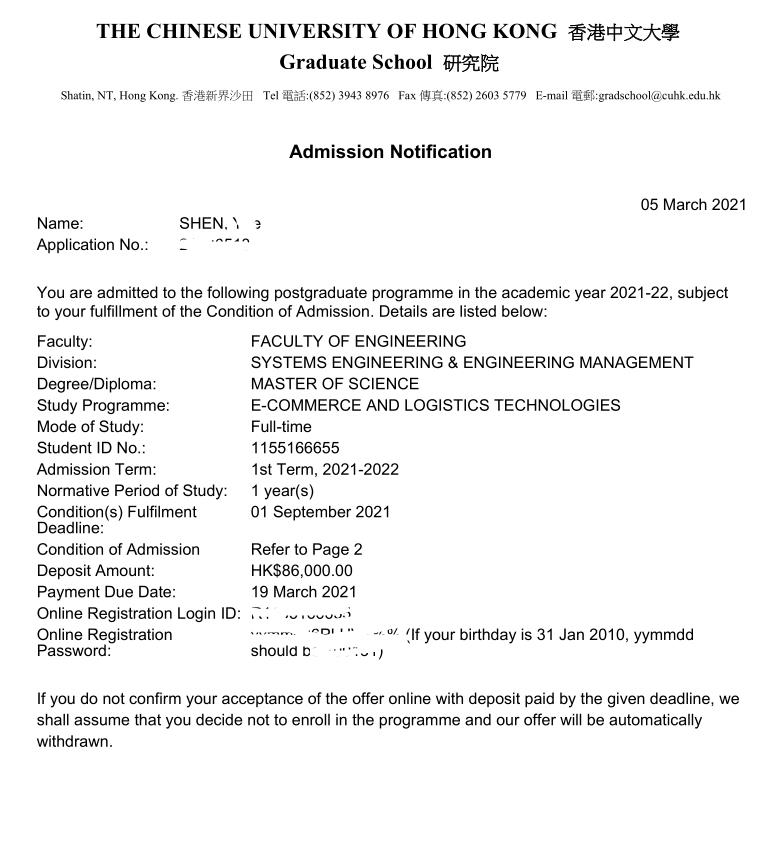
E-commerce technologies have been widely and successfully used for management and operations of business firms and organizations today. Typical examples include: e-banking, online trading of stock markets, procurement of enterprises through Internet, online shopping, Internet marketing, e-government services, etc. For supply chains involving multi-national operations, Internet has become a necessary means to facilitate business transactions and coordination. "Logistics technologies" studied in our programme deal with not only traditional transportation logistics of moving cargos from one location to another, but also all kinds of operational logistics associated with running business making use of Internet technologies. The curriculum of our programme has been carefully designed to reflect the latest technological developments and to meet the needs of industries, to prepare our students for success upon graduation and leadership in the future.
院校解读
留学方案
案例分析
| Course Descriptions |
 |
| Fundamentals of E-commerce Technologies - ECLT5710 An overview of the principles of E-Commerce. The origin and growth of E-Commerce. Technologies that support the development of E-Commerce applications. Business models and strategies for E-Commerce. Legal issues related to E-Commerce such as privacy, consumer rights, and intellectual property. Information interchange and application sharing via extensible markup languages and web services to support logistics and operation management. Electronic Payments Systems - ECLT5720 This course covers various methods of transferring payments over the Internet and compares their functionality. Topics include electronic money, electronic contracts, micro-payments, authenticity, integrity and reliability of transactions, the encryption and digital signature techniques needed to support electronic cash, and the technologies available to support secure transactions on the Internet. Logistics Management - ECLT5730 The integrated logistics management concept. Customer service. Channels of distribution. Order processing. Transportation systems. Storage and material handling systems. Inventory management. Information systems for order processing & inventory tracking. Impact of Internet and electronic data intercharge (EDI) on order cycles, vendor-customer communications and inventory. Global logistics. Third-party logistics. Cryptography, Information Security and E-Commerce - ECLT5740 Symmetric cryptography. Asymmetric cryptography including integer factorization, discrete logarithm, and elliptic curve. Digital signature, one-way hashing, zero-knowledge proof, certificate and certificate authority. Secure information infrastructure, virtual private network (VPN), online shopping and payment systems, e-cash. Economic impact. Smart card, steganography, time stamping. Cryptanalysis technology. Authentication protocols, analysis, and evaluation. E-Commerce Data Mining Techniques - ECLT5810 Data mining provides techniques for the analysis, understanding and extraction of useful information from huge databases. These techniques are used in business, finance, medicine and engineering. This course will introduce the techniques used in data-mining for E-Commerce information. Topics will include clustering, classification, estimation, forecasting, statistical analysis and visualization tools. Distributed and Mobile Systems - ECLT5820 Distributed and mobile systems are the key framework for E-Commerce applications. This course covers the principles of distributed systems (including mobile applications) and software, and the engineering mechanisms for their specification, design, deployment, and evaluation. Topics include: architectural models for distributed systems, server techniques, remote procedure call and multicast communication, RFID technology, emerging standards and platforms, distributed transactions, concurrency control, reliability and security issues. Network and Web Programming - ECLT5830 This course addresses the techniques for programming in both low-level (Network) and high-level (Web) of internet. Network programs includes: Client-server system design; interprocess communication; sockets; blocking and nonblocking I/O; multithreaded process;iterative and concurrent server designs; Web programming includes: HTML, JAVA, Web page design and contruction. Open Systems for E-Commerce - ECLT5840 Introduction to open system standards and protocols. Transaction protocols. Electronic commerce applications using open system and artificial intelligence technologies. Application of intelligent agents for automated transaction processing. Integration of Web programming techniques with information and communication systems. Case studies for E-Commerce open system applications. Project I in E-Commerce and Logistics Technologies - ECLT5850* An individual or a team project on E-Commerce technologies. Information Technology Management - ECLT5910 The challenges, techniques and technologies associated with the management of information technology (IT) for logistics and supply chain operations. The linkage of IT to busines models and corporate strategies in logistics and supply chain industry. Information systems and technology planning, sourcing and acquisition, budgeting and deployment. Performance evaluation and audit. Standard, privacy and security polices. Decision Methodology with Financial Application - ECLT5920 Utility functions, and mean-variance theory. Probability models and price dynamics of securities. Financial analysis models including: Geometric Brownian motion,Ito's lemma, Black-Scholes model. Capital aset pricing. Models of risks. Risk hedging. Optimization techniques for investment and portfolio management. Engineering Economics - ECLT5930 Principles of engineering economy. Value and cost, cash flows. Economic analysis of alternatives, technological, social, and human factors. Models involving allocation and scheduling of resources. Analytical techniques for evaluating industrial projects. Relationship between economics of technical choice and industrial productivity. Basic financial accounting concepts, accounting cycle, financial statements. Supply Chain Management - ECLT5940 Management of moving raw materials, in-process inventory, and finished-goods; transferring information and payment. Topics include: electronic information and payment transfer and its impact, distribution, forecasting, inventory management, purchasing and supplier management, ERP systems supply chain integration and strategic partnering. Impacts of E-Commerce in supply chain management. Project II in E-Commerce and Logistics Technologies - ECLT5950* An individual or a team project on E-Commerce technologies. Project I and Project II in E-Commerce and Logistics Technologies are designed to allow students to gain first-hand experience in studying and developing real-world systems for E-Commerce. These could be conducted either individually or by team work. It is expected that students will be involved in projects for the industrial "pilot programmes" of the Centre for Logistics Technologies and Supply Chain Optimization (LOGITSCO) at the Faculty of Engineering. Possible projects include, but are not limited to:
|